under evaluation
LoRa Mesh
We set out with an idea: local-first peer-to-peer PWAs that keep running over a LoRa® mesh when the internet or the power grid fails — and in places that have neither. The measurements did not bury that idea; they cut it to size. The radio carries no everyday data volumes — but it carries handshakes, bookings and signed events reliably across kilometres, with no infrastructure anyone has to operate. What the evaluation produced is a class of applications: mesh-calendar, an experimental appointment manager for hairdressers, already runs in those bytes.
Findings
- 6 September 2026 — a booking crossed the mesh. Two Meshtastic nodes, EU 868, the slow default preset, and no IP path anywhere: a shop's opening rules travelled to a laptop that had never seen them and rendered as fourteen days and thirty-six slots; a booking travelled back and appeared in the shop's own day plan 31 seconds later. The whole session — rules, busy mask, booking — cost 9.3 seconds of airtime, about 2.5 % of what EU 868 grants a transmitter in an hour. That is the same radio on which a three-entry todo list is visibly sluggish. Nothing about the radio changed; the shape of the data did. The demo runs in a browser, with two tabs standing in for the radios if you have none.
- Throughput: replicating even a todo list of three short entries is noticeably sluggish — and the radio is only half the explanation. The test setup used OrbitDB with network sync switched off: the courier carries the content-addressed blocks itself and side-loads them straight into the local blockstore, past the IPFS network entirely. First contact is the heavy part — manifest, access controller, identity and entries cross as a block bootstrap of a few kilobytes, roughly halved by gzip — and even afterwards, signatures and identity references keep every entry hundreds of bytes. On top sits the duty-cycle limit (EU 868: ~6 minutes of airtime per hour). The courier itself works — built and tested in funkpost, and on 4 September 2026 it first ran over a real LoRa mesh between two independent nodes, a desktop browser either side — but standard office applications are ruled out. The setup can be tried live: the demo replicates a todo list across the mesh — or, with ?mesh=bc, across two browser tabs, no radio required.
- As a fallback for internet or power outages the current adaptation is unsuitable: it ships whole OrbitDB blocks, which the data rate does not carry. A follow-up release is already being considered that works the way mesh-calendar does — a few bytes of text per event instead of block transfers. What no release removes: every participant would still need radio hardware.
- Platform: Web Bluetooth runs only in Chromium on Android and desktop — no iOS browser. An iOS device is not locked out, though: over Wi-Fi — a mobile hotspot is enough — it can reach a node through Meshtastic’s HTTP/TCP API; a native app would also work and sits outside this evaluation. Device variance is real: a GrapheneOS phone talks to the node noticeably more stably than Android Chrome.
- Adoption: hardly anyone carries a radio node today. That is less a verdict than the actual design problem: commercial applications need ideas that do two things at once — spread the nodes and offer a benefit that justifies carrying one. A use case with a clear USP distributes its own hardware.
What remains
Three planes share the one radio and nothing else. The first — OrbitDB replication — has run, and what it cost is in the findings above. These two are what remains:
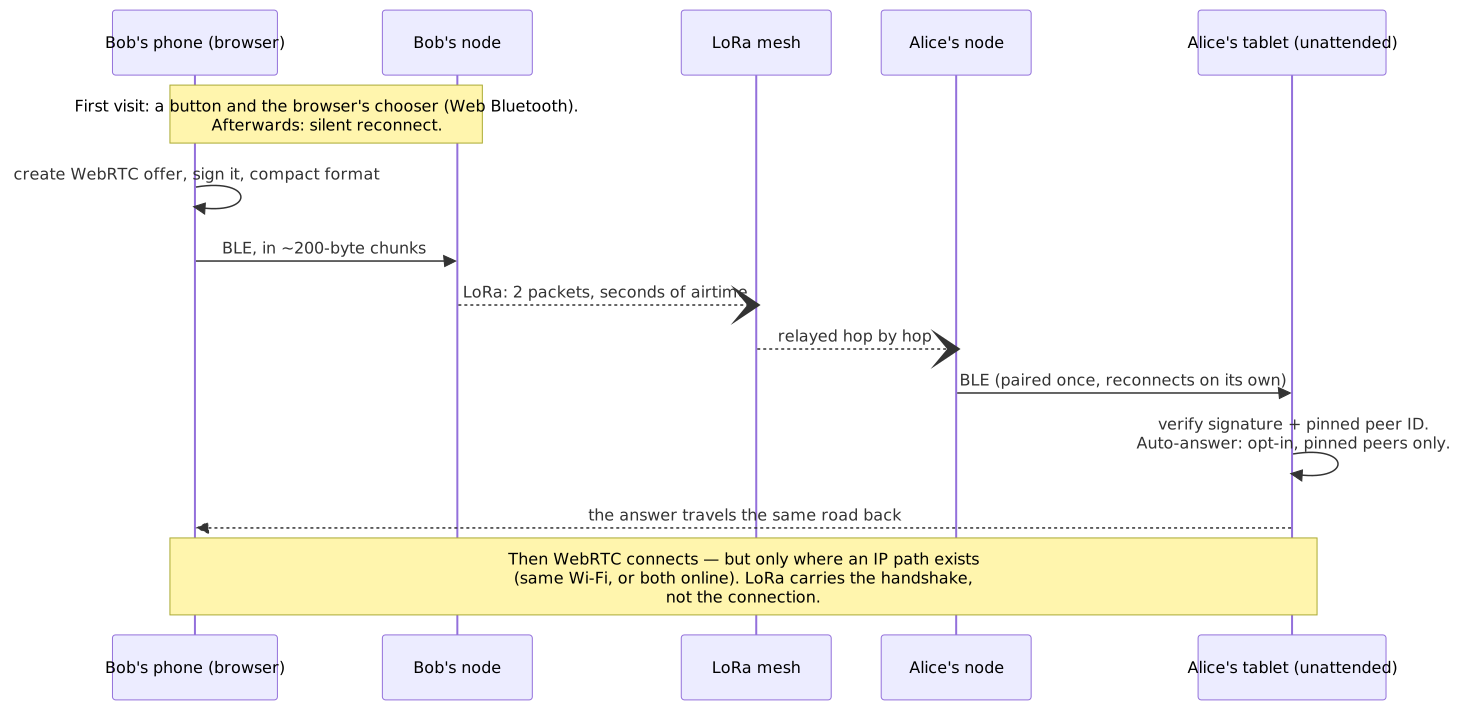
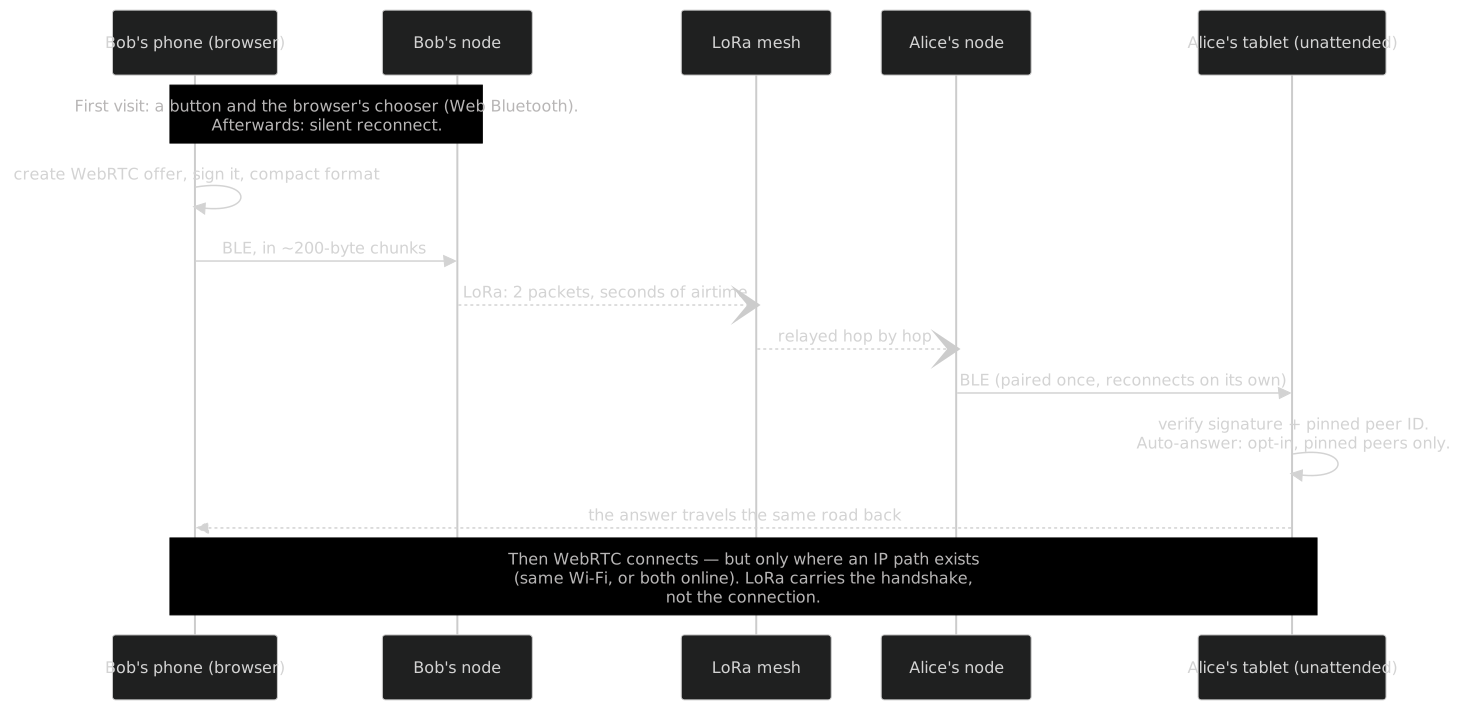
A courier for small, rare, valuable payloads. The signalling handshake from design issue #161 fits in two frames; a single signed event — a booking, a handover confirmation — in a few. Where minutes of latency are acceptable and infrastructure is absent, the model still holds — and metadata that is never generated cannot leak.
Try a plane
Both run in the browser. With ?mesh=bc two tabs stand in for the two radios, so neither needs hardware to try; a Meshtastic® node over Web Bluetooth makes it real. They are demonstrators, not products — the menu page says what that means.
Technical foundations
- funkpost — the byte courier itself: framing, ARQ and duty-cycle pacing over Meshtastic® radios — two data planes built (OrbitDB and Yjs), signalling plane designed; live demos.
- webrtc-qr — the library: two devices connect by scanning a code — no signalling server.
- qr01 — the tutorial chapter for this: a todo list moves from phone to phone by scanning a code — over a Wi-Fi hotspot, with no internet involved.
- the demonstrators — both live in the browser: a todo list replicating across the mesh (OrbitDB), and an appointment book for a shop around the corner (Yjs). With ?mesh=bc two browser tabs stand in for the radios; a Meshtastic® node over Web Bluetooth makes it real.
Test channel
Two radios only hear each other if they carry the same key — and if they do not, nothing arrives and nothing says so, which looks exactly like an empty room. This is ours, published on purpose: a meeting place for anyone wanting to try the demonstrators with someone else. It is not a secret, and nothing in them was protected by the channel key in any case.
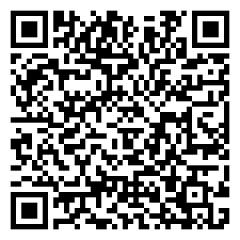
le-space.de · EU_868 · LONG_FAST · ⌗3dd3
Both demonstrators print that fingerprint beside the channel selector. It is worth comparing across devices: a channel can carry a familiar name and a completely different key, and the name will not tell you.
Importing replaces the entire channel set — every other channel on the device is erased, including keys that exist nowhere else. Export what is on there first.
- Role CLIENT_MUTE — a default node rebroadcasts everything it hears, and on a busy mesh that is most of its airtime, spent on strangers’ packets. Muted, it carries only its own.
- Preset SHORT_TURBO for heavy testing — 21,880 bit/s against LONG_FAST’s 1,070, so the same frame costs a twentieth of the air, and range is irrelevant across a desk. It is deliberately not baked into the channel above: the preset is part of the air configuration, so everyone testing together has to switch at once or they stop hearing each other.
The band is shared and legally rationed — EU 868 gives each transmitter about six minutes of airtime per hour, and a community mesh may have a hundred neighbours in earshot. Bench etiquette has the rest, and channels explains how to make your own.
Related work
- btcmesh — sends signed Bitcoin transactions over a Meshtastic mesh to a relay that broadcasts them — the same courier pattern, applied to money.
- darkwire — a Bitcoin 2025 hackathon project: an end-to-end Bitcoin transaction over LoRa, with no internet anywhere on the sender's side.
- Reticulum — the scene’s cryptography-first mesh stack — runs over LoRa, packet radio, Wi-Fi and everything in between; internationally the best-known work of this kind.
- MeshCore — a leaner LoRa mesh firmware currently building its own community in Germany alongside Meshtastic.
- qaul — a messenger for internet shutdowns — devices connect directly over Bluetooth and Wi-Fi; well known in the net-freedom scene.
Communities within reach
- Munich Mesh — the Munich Meshtastic community.
- Berlin Chaos Mesh — Berlin’s mesh community around the c-base — Meshtastic, MeshCore and Reticulum.
- MeshHessen — a regional mesh across the state of Hesse.
- Meshtastic local groups — the directory of all local groups, from the D-A-CH Telegram to lora.ms.
Exchange
We share measurements and the test setup. Anyone working in the same niche — Meshtastic practitioners, researchers, local-first developers — is welcome to get in touch.
Get in touch — contact@le-space.de Telegram · @lfp2p X · @nicokrausex
On the mesh, we can be reached at le-space.de e45c, YSGs0MrcH9QOcAlIxvYkJWaV64AvKgx/tXS27SiCzXM=
The public key is what identifies us; node names are assigned by whoever operates the node. It radios in the EU-868 region and is mobile — reachable wherever it currently has a mesh in range.
LoRa® is a trademark of Semtech Corporation. Meshtastic® is a registered trademark of Meshtastic LLC. Meshtastic software components are released under various licenses, see GitHub for details. No warranty is provided - use at your own risk. This site is not affiliated with or endorsed by Semtech or the Meshtastic project.